Moving Beyond Segmentation

Customer intelligence and behavioral profiling for a more focused email marketing campaign

Last week I discussed tapping into rich subscriber data to deliver a unique customer experience. Grouping customers into one catch-all segment no longer works. A highly targeted email marketing strategy means a higher campaign conversion rate.

When it comes to their online marketing strategies, marketers must increasingly rely on technology to deliver more relevant messages to the right person at the right time.

Don’t Mistarget Your Marketing Efforts

To be successful, marketers need to send the right message to the right customer at the right time. According to a 2011 study by Blue Research, if you personalize the experience between you and your subscribers, they are 50 percent more likely to return to your site, and 40 percent more likely to recommend you to others.

Tap into rich subscriber data to deliver unique customer experience.

Tapping your subscriber data is a key component of an effective email marketing program. Subscriber data can come from a variety of sources—observed web behavior, purchase data, stated preferences, CRM notes, social, email, surveys and more. Analyze this information and use insights gleaned (e.g., sentiment, demographics, individual influence, behavior) to create engaging customer experiences that build stronger, more intimate relationships and foster long-term loyalty.

Win $250 – Enter Your Best Email Design of 2012!

You worked hard in 2012 designing email templates that produced high conversion rates, generated traffic to your site and maximized your email marketing ROI. If you think you have created an award winning email, enter to win a $250 American Express Gift Card.

The rules are pretty simple. Send us your design by February 1, 2013. A panel of email marketing experts will review and score the entries. In March, we’ll announce our winners! Read our official rules below and enter today.

Good luck!

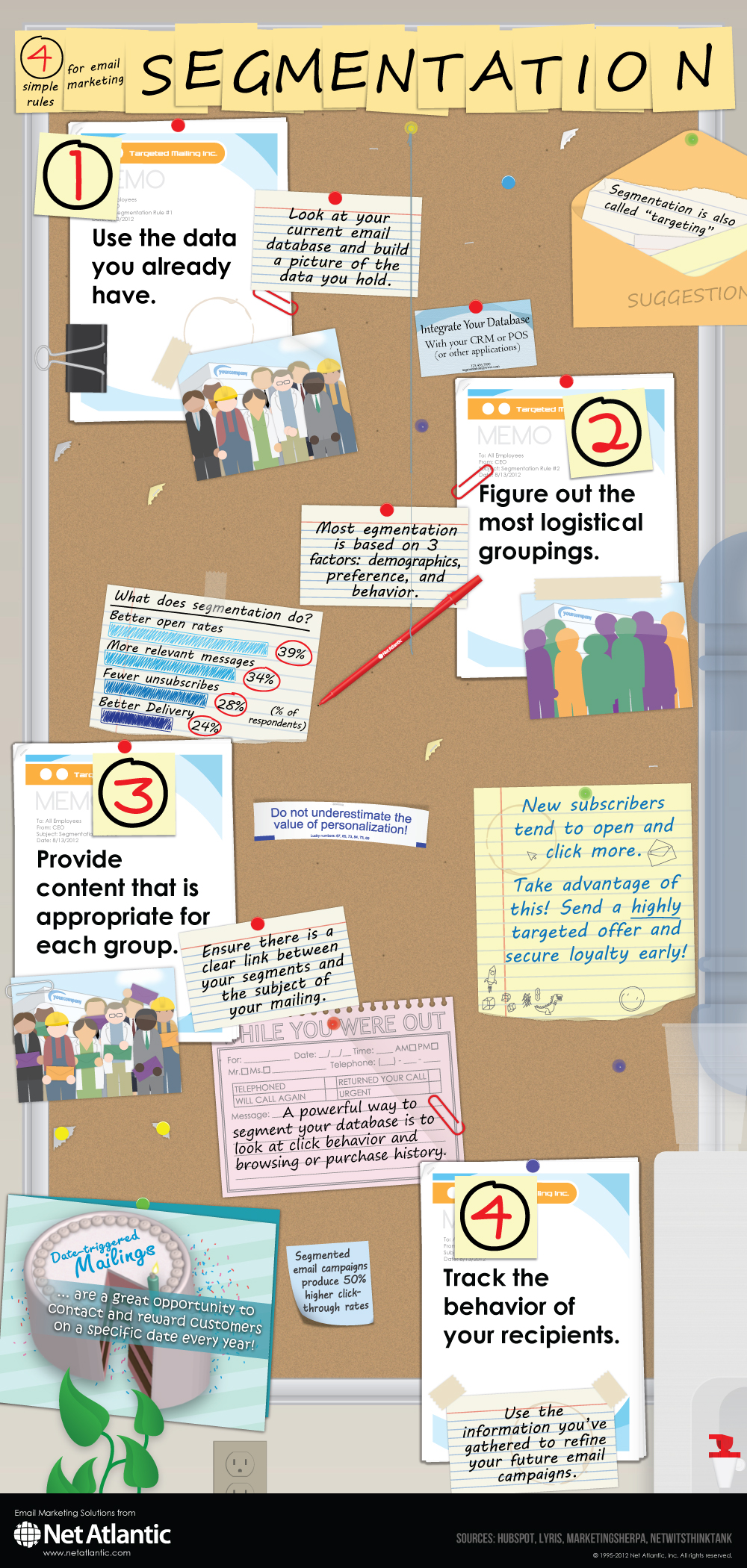
Infographic: 4 Simple Rules for Email Marketing Segmentation

Segmenting your email marketing campaigns doesn’t need to be a daunting task. We’ve simplified the process of dividing your email list into groups of likeminded individuals and sending personalized messaging into 4 simple rules. These rules will allow you to send targeted and personalized messages to groups of people who share similar characteristics. Although segmenting your list takes more time and effort, it gets your email to the people who want it the most, increasing the probability of recipients opening, reading and, ultimately, doing business with you. Segmenting at its most basic—using data you already have—will result in significantly higher conversion rates than one-off email blasts.

Follow the 4 Simple Rules for Email Marketing Segmentation illustrated in the infographic below to increase the effectiveness of your email marketing campaigns:

4 Simple Rules for Email Marketing Segmentation

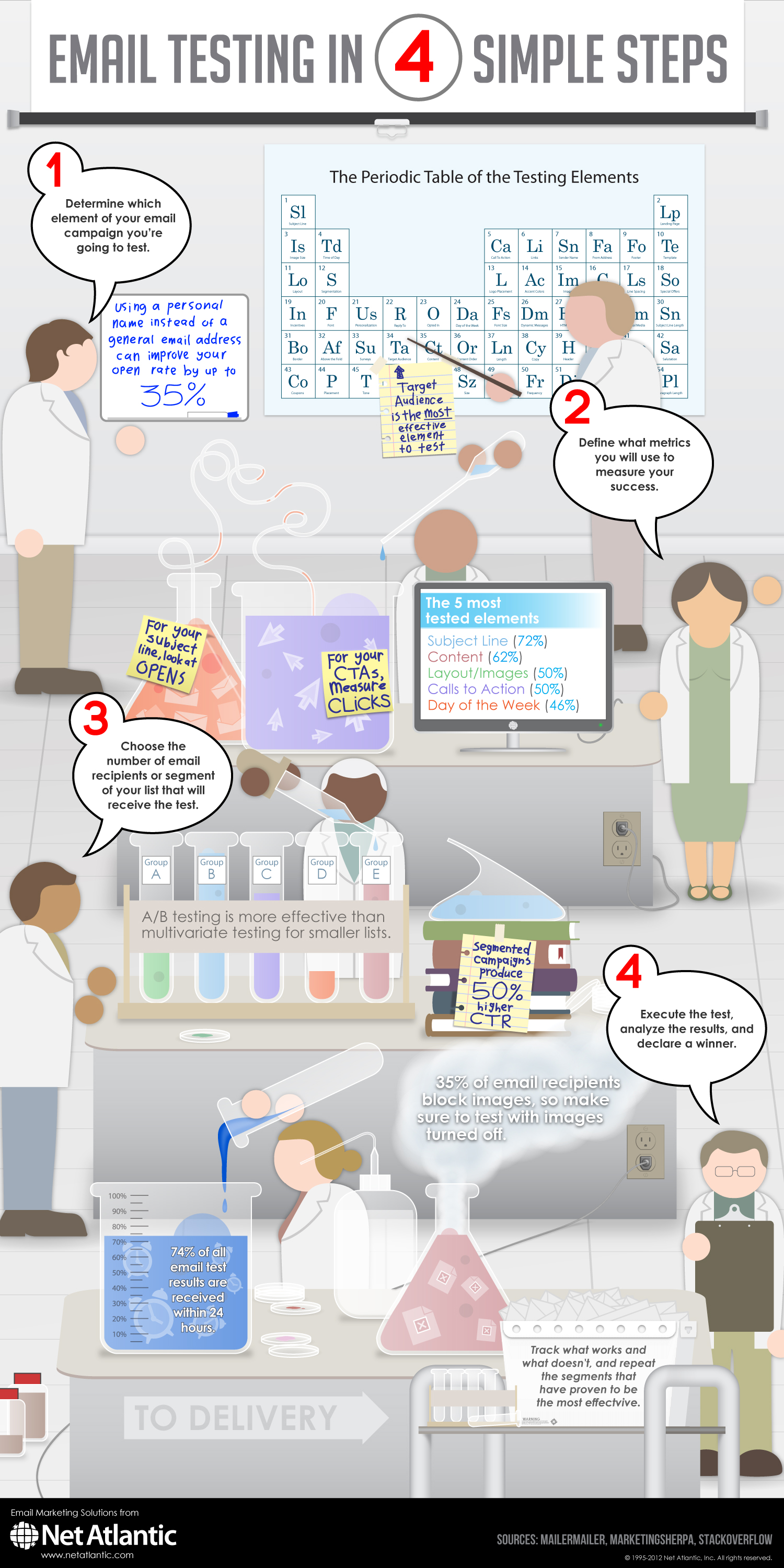
Infographic: Email Testing In 4 Simple Steps

Email marketing best practices dictate that testing be performed for each mailing you send out. And it makes sense! Why would you want to distribute what would otherwise be a broken email message to your carefully cultivated audience? So many things could go wrong (e.g., improperly formatted HTML, images not loading as planned, incorrectly entered merge tags, etc.) that it’s worth the extra few moments to ensure that your communications go out without a hitch. But that’s just testing for delivery. How about testing for effectiveness?

Testing your email content — and in a larger sense, your message — is an often overlooked step in the email marketing process despite it being a best practice. And it’s kind of silly that it’s so often forgotten about, really. Why wouldn’t you want what you send to be the most effective it could be? Much as you want to ensure the technology supporting the transmission of your communication is functioning as intended, you should also see to it that your message is producing the results you set out to achieve. But how do you do that? What do you change to make your campaign more effective? How do you measure this change?

Given its undeniable tie to the success of your campaigns, email testing is a pretty big deal. And unless you are 100% satisfied with your email marketing effort’s performance as is, it’s a big deal that you should probably address. But don’t fret; while it may seem somewhat complicated, fundamentally it’s a pretty simple process.

Our Email Testing In 4 Simple Steps infographic illustrates exactly how simple it is.

Email Testing in 4 Simple Steps

4 Critical Phases of Email Marketing Automation

A properly implemented email marketing campaign works much like a well-oiled machine. It’s effective, only requires a moderate amount of maintenance and supervision and produces results with little actual effort from its operators beyond its initial setup. And what’s more, it’s not this long, drawn out, manual experience each and every time you want to send out an individual mailing. You just set things up and it just hits the ground running, pretty much on its own.

What? That’s not been your experience? You’re doing what? Oh! Perhaps you haven’t been getting the most out of your email marketing machine. Perhaps you haven’t been apprised of the benefits of automation.

With automated campaign management tools, you can improve the timeliness of your email communications with customers without a thought, coordinate multiple engagement efforts simultaneously and, coupled with personalization, segmentation and relevant content, reach out more effectively to your audience with ease as your platform simply does it for you. Rather than go through the tedious, time-consuming and mentally taxing tasks involved in doing every single step in the mailing process yourself, use the tools available to you as an email marketer. You can then concentrate on what’s most important to your communications instead: your message.

Check out our infographic on the 4 Critical Phases of Email Marketing Automation to learn more!

Testing the Waters of Email Marketing

With any advertising approach that involves a mailing strategy, campaign testing is a vital component in getting the best return results with the resources you have available. Direct mailing has been the foundation of companies’ marketing strategies for generations, and still remains a dependable and reliable source of getting your message sent straight to the mailboxes of your customers.  However with the expansion of the ever popular social media methods, DM is often the first thing to be eliminated.  Because of this, it is important to adapt and expand your methods and focus on email marketing and the right type of campaign testing to prove that the physical piece alongside online mailing is still bringing in returns.

Test This, Not That: Email Campaign Testing Beyond the Subject Line

Test This, Not ThatI’m sure you’ve read it before: employing testing as an optimization tactic has been proven to be an extremely efficient means of increasing email marketing performance. What you may not have read is that the most widely used testing strategies are not always the most effective.

Drive Engagement: Automate Your Lead Nurture Strategy

When creating your lead nurturing campaign it’s important that you carefully plan the flow of your emails to ensure that your overall campaign guides your leads through the funnel. Implement automatically triggered campaigns (a series of automated emails called a “drip” campaign) that deliver consistent brand messages at specified time intervals and when leads reach certain milestones. In a long sales cycle, messages need to be more informative and not a sales pitch. Offer them something of value (webinars, eBooks, white papers, articles, free reports, blog posts, etc.).

Here are five essential elements of an effective lead nurturing campaign:

Meet Your Consumers: Browsing Bob, Maybe Mike, and No-way Ned

Meet Your Consumers: Browsing Bob, Maybe Mike, and No-way NedThere are three types of consumers: those who want to buy your product, those who might want to buy your product, and those who definitely don’t want to buy your product. For simplicity’s sake, let’s refer to these types of consumers as Browsing Bob, Maybe Mike, and No-way Ned, respectively. These consumers often times end up on your email marketing list. To keep your email marketing relevant to your subscribers you should know what type of consumers are receiving your emails.

Browsing Bob is “in the market,” as they say, actively searching for something specific to buy. Maybe Mike, while he might not be seeking you out, will be responsive if he sees a relevant advertisement that catches his eye. No-way Ned, even if he does see an advertisement, has no interest in whatever you’re selling.